13 August 2026 · 6 min read
10 Times Harry Potter Quietly Told You What Was Going to Happen Next
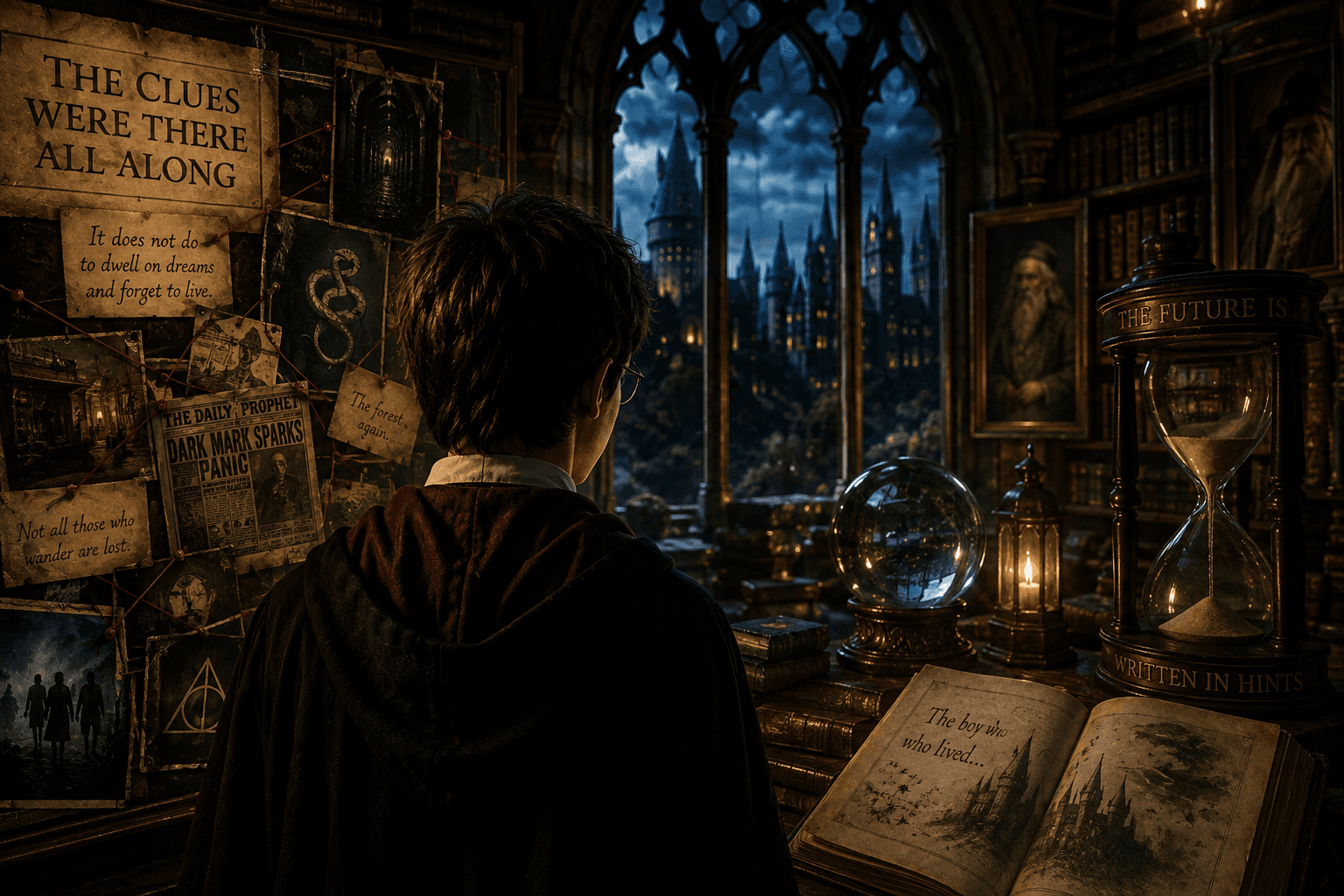
10 Times Harry Potter Quietly Told You What Was Going to Happen Next
One of the reasons Harry Potter is so satisfying to reread is that the story rarely hides everything from you.
Sometimes, the biggest twists are sitting right there.
A sentence.
An object.
A strange reaction.
A tiny detail in the background.
You simply don't know that it matters yet.
Then you finish the series, go back to the beginning, and suddenly think:
"Wait. They told us this years ago."
Here are 10 moments where Harry Potter quietly planted clues about what was coming next.
1. The Mirror of Erised tells us exactly what Harry wants
When Harry first discovers the Mirror of Erised, he sees his parents standing behind him.
At first, it feels like a magical curiosity.
But the scene is actually telling us something essential about Harry.
His deepest desire isn't power.
It isn't fame.
It isn't revenge.
It is belonging.
That becomes incredibly important later, because Harry's greatest battles are ultimately about love, family, sacrifice, and the people he refuses to lose.
The mirror introduces the emotional engine of the entire story before Harry even understands it himself.
2. The sorting of Harry foreshadows his entire character
The Sorting Hat considers putting Harry in Slytherin.
Harry refuses.
That moment looks like a simple introduction to the Hogwarts houses.
It isn't.
Harry spends the entire series repeatedly proving that your choices matter more than your circumstances.
He has many qualities that could have made him a Slytherin.
He can be ambitious.
He can be cunning.
He breaks rules.
He is resourceful.
But he chooses Gryffindor.
Later, when Harry is tempted by fear, power, or anger, the story repeatedly returns to the same question:
What will Harry choose?
The Sorting Hat basically gives us the answer to the series' biggest theme in Book One.
3. Sirius Black's name is a giant clue
Sirius Black is introduced as a terrifying fugitive.
The wizarding world believes he betrayed Harry's parents.
His name even sounds ominous.
But Sirius is not the monster everyone believes him to be.
He is one of Harry's greatest allies.
And his name gives us a clue that something about him isn't what it seems.
Sirius is the name of the brightest star in the night sky, often called the Dog Star.
And Sirius Black is an Animagus who transforms into a large black dog.
The clue isn't just clever wordplay.
It is the kind of detail that makes a reread feel completely different.
The story was quietly telling you what Sirius was long before you knew to look.
4. Scabbers is sitting beside Ron the entire time
This might be one of the most ridiculous clues once you know the truth.
Peter Pettigrew is hiding in plain sight.
For years.
He's literally sleeping in Ron's room.
Eating food.
Riding around Hogwarts.
And everyone assumes he's just a rat.
The revelation in Prisoner of Azkaban feels shocking the first time.
On a reread, it feels almost unfair.
Because the evidence was sitting there the entire time.
The man who betrayed Harry's parents wasn't hiding in some secret dungeon.
He was hiding in the Weasley household.
In other words:
The story didn't hide Pettigrew. We did.
5. Tom Riddle's diary tells us what Horcruxes can do
When Harry encounters Tom Riddle's diary, it seems like a dangerous magical object.
But it is also the first real demonstration of what a Horcrux can accomplish.
The diary doesn't simply preserve a memory.
It contains a version of Tom Riddle capable of influencing another person, communicating, and attempting to return to physical existence.
Later, we discover the truth about Horcruxes.
And suddenly the diary becomes much more important.
It was the first example.
The story showed us the mechanism before giving us the explanation.
6. The snake in the graveyard foreshadows Nagini
During the graveyard sequence, Voldemort's snake is always nearby.
At first, Nagini simply seems like an intimidating companion.
Later, we discover that Nagini is far more important than that.
She is one of Voldemort's Horcruxes.
That makes every earlier appearance of the snake more interesting.
The creature that looks like decoration is actually carrying a piece of Voldemort's soul.
It is another example of Harry Potter hiding major information inside something that initially appears ordinary.
7. The Thestrals quietly prepare us for death
Harry cannot see the Thestrals when he first arrives at Hogwarts.
Then, after witnessing Cedric's death, he can.
That seems like a strange magical detail.
But it becomes one of the most powerful visual metaphors in the series.
The people who can see Thestrals have experienced death directly.
And Harry's ability to see them marks a turning point.
He is no longer simply a child discovering magic.
He has seen death.
From that point forward, the story becomes darker.
The Thestrals are effectively telling us:
Harry's childhood is over.
8. The Half-Blood Prince's book is telling us who Harry is becoming
Harry finds a mysterious textbook filled with handwritten notes.
At first, the notes simply make him better at Potions.
Then he discovers the person behind them.
Severus Snape.
The important clue is not merely that Snape wrote the book.
It is that Harry becomes fascinated by someone else's cleverness without understanding the complicated person behind it.
That mirrors Harry's larger journey.
Throughout the series, Harry repeatedly learns that people are more complicated than the labels attached to them.
The "Half-Blood Prince" revelation is another version of that lesson.
9. Harry's scar is more than a scar
Harry's scar is introduced as the physical mark left by Voldemort.
But it becomes a connection.
Harry can sometimes feel Voldemort's emotions.
He experiences visions.
He sees things happening elsewhere.
The scar is effectively an early warning system.
The story spends years teaching us that the connection between Harry and Voldemort is unusual.
By the time we learn the truth about the Horcrux inside Harry, the clues have been everywhere.
The scar was never just a souvenir from the night Voldemort attacked.
It was evidence of a connection neither Harry nor the audience fully understood.
10. Dumbledore keeps talking about love—and that is the real answer
This might be the biggest clue of all.
Throughout the series, Dumbledore repeatedly talks about love.
Harry initially thinks this sounds like a nice speech from an old wizard.
But eventually, we realise that Dumbledore has been pointing toward the central weakness of Voldemort the entire time.
Voldemort understands power.
He understands fear.
He understands domination.
He does not understand sacrificial love.
Harry does.
His mother's sacrifice protects him.
Harry later chooses sacrifice himself.
And that choice ultimately becomes the weapon Voldemort never understood.
The final victory is therefore not really about Harry becoming more powerful than Voldemort.
It is about Harry understanding something Voldemort never could.
The genius is that Harry Potter rewards hindsight
The best foreshadowing doesn't make you think:
"Ah, that's obviously important."
It makes you think:
"Wait... that was there the whole time?"
That's why the series is so much fun to revisit.
A second viewing isn't really the same story.
You know what happens.
But now you notice why it happens.
A rat isn't just a rat.
A diary isn't just a diary.
A snake isn't just a snake.
A scar isn't just a scar.
And a conversation about love isn't just a conversation.
The story was quietly telling you the ending.
You just didn't know how to listen yet.
harry potter · foreshadowing · hidden clues · wizarding world · easter eggs · theories · details · reread